The Institute of Thermal Turbomachinery and Machinery Laboratory (ITSM) of the University of Stuttgart, based in Germany, focuses its research on gas turbines, steam turbines and turbochargers. As part of the FVV-funded project “Blade Forces”, the Cadence software tools were utilized. The goal was to develop a workflow for the accurate, reliable and affordable prediction of forced response vibrations in radial turbines taking into account mistuning effects. A thorough validation of this workflow was conducted experimentally and numerically.
Meshing
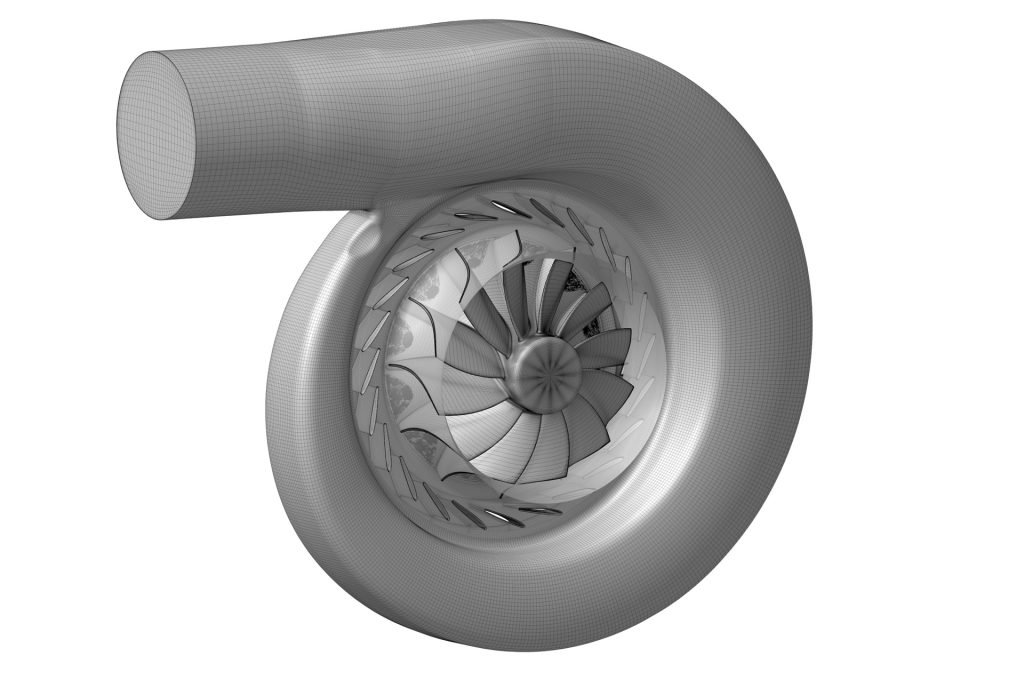
On the numerical side, high-fidelity CFD models comprising block-structured grids were created with the automatic mesh generator Autogrid including details like the blade tip gap and fillets as well as the rotor scallop and backspace. The turbine volute was also included in the model.

Nonlinear Harmonic Approach
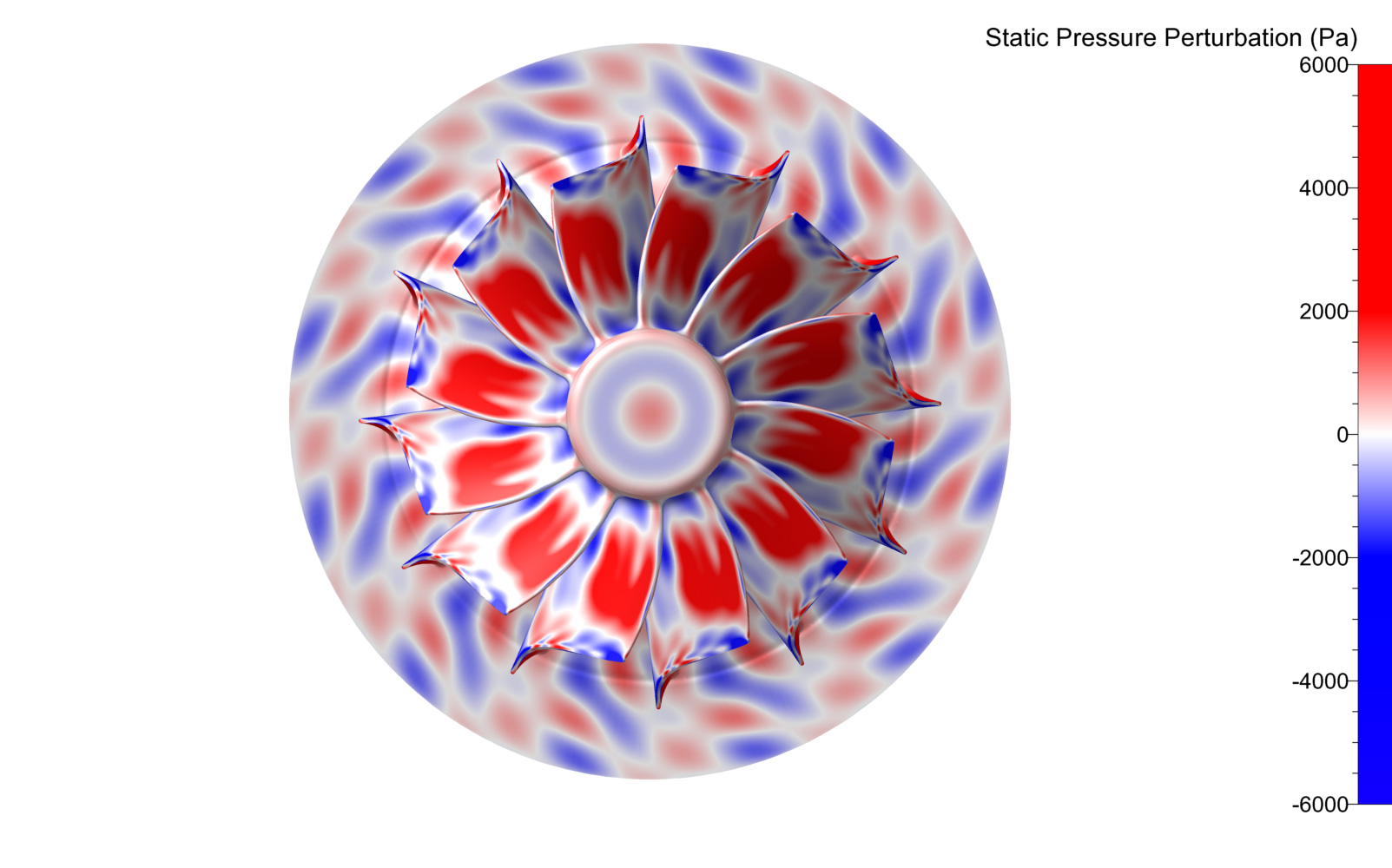
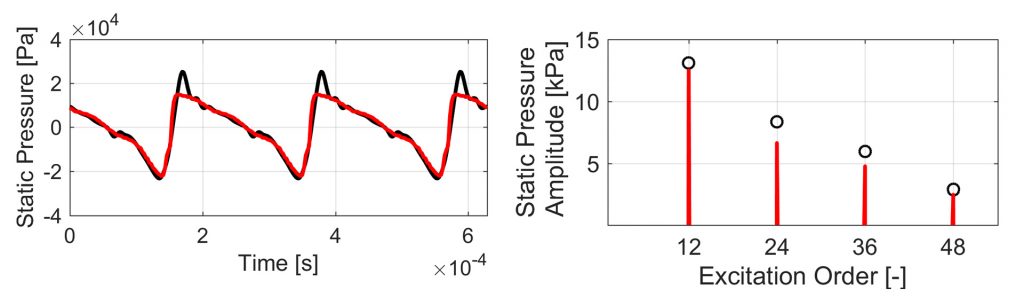
The unsteady flow field in the turbine giving rise to the aerodynamic excitation was simulated by means of the innovative multi-rank Nonlinear Harmonic (NLH) frequency domain approach in Fidelity Fine Turbo. It leads to a comparable accuracy of the numerical results as the state-of-the-art time-marching models at significantly reduced computation costs. A validation with unsteady pressure measurement data showed remarkably good agreement and increased our confidence in this numerical method and in Cadence’s solver.
Aerodynamic Damping
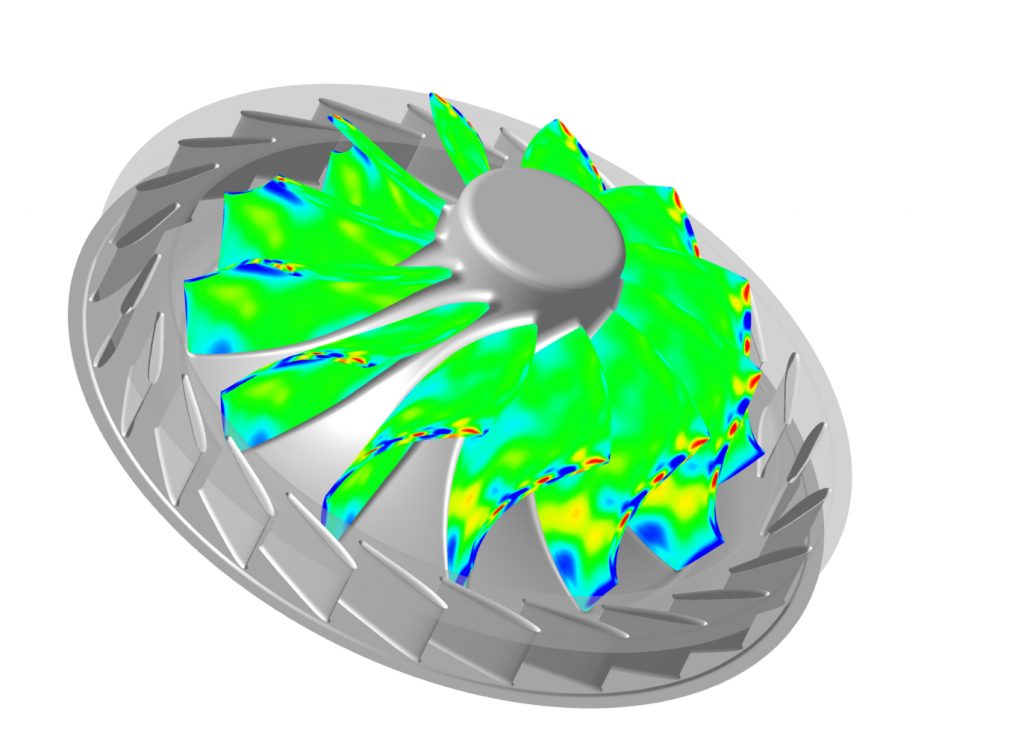
The aerodynamic damping in the turbine was also predicted by means of the NLH method. For this purpose, the mode shapes of the investigated resonance crossings as obtained from a prior modal analysis were applied as an elastic blade vibration with defined vibration amplitude. By utilizing the NLH method, the aerodynamic damping was computed also with high accuracy and low computation time.
Given the excellent performance of Cadence’s software tools, we look forward to employ them in other projects and to continue our cooperation with Simuneer as an academic partner.
Authors
- Nikola Kovachev, Research Engineer
- Tobias Müller, Research Engineer
- Prof. Tekn. Dr. Damian Vogt, Institute Director, Institute of Thermal Turbomachinery and Machinery Laboratory (ITSM), University of Stuttgart
References
- Kovachev N., Müller T., Waldherr U., Vogt D., Prediction of Low-Engine-Order Excitation due to a Non-Symmetrical Nozzle Ring in a Radial Turbine by Means of the Nonlinear Harmonic Approach, ASME Paper, GT2019-90366
- Kovachev N., Waldherr U., Mayer J., Vogt D., Prediction of Aerodynamically Induced Blade Vibrations in a Radial Turbine Rotor Using the Nonlinear Harmonic Approach, ASME Paper, GT2018-76814